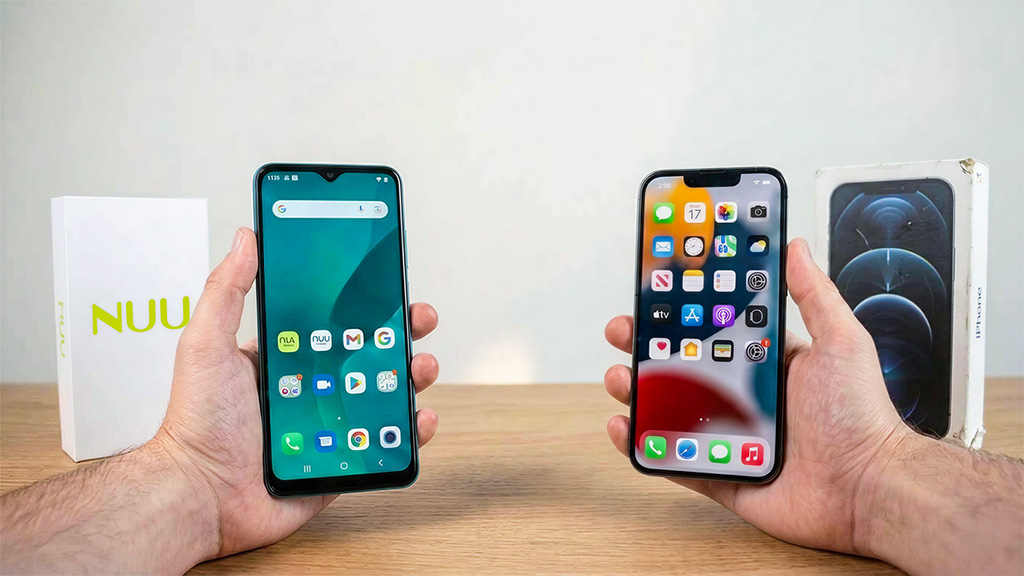
You have $200. Maybe $300 if you stretch. On one side: a previously owned, older, refurbished iPhone with unknown battery life, no manufacturer coverage. On the other: a brand-new Android, full box, fresh battery, twelve-month warranty, certified by Google. Both hit the same price tag. The question is not which logo you prefer. It is which one actually costs less over the next two years.
What You Actually Pay Over Two Years
The sticker price is the wrong number to compare. A refurbished iPhone at $250 and a new NUU Android at $250 are not the same transaction. They carry different cost structures that play out across the following 24 months. The table below runs the likely spend for each across the variables that actually determine what you pay: warranty coverage, battery condition at purchase, repair probability, and software runway.
Two-Year Ownership Cost: Refurbished iPhone vs. Brand-New Android
| Cost Factor | Refurbished iPhone (e.g., iPhone 12) | Brand-New Android (under $300) |
|---|---|---|
| Device purchase price | $130 – $180 | $79 – $299 |
| Manufacturer warranty | None (expired) | 12 months included |
| Battery replacement (probability in yr 1) | ~40% chance, $69 avg | New battery — not applicable |
| Screen repair risk (pre-owned handling history) | Unknown — no inspection disclosure required | Zero prior drops or pressure |
| Software update runway (as of 2026) | iPhone 12: iOS 20 supported, uncertain beyond 2027 | Android 14 out of the box, with ongoing manufacturer security patches. |
| GMS / Play Store certification | Yes (iOS ecosystem — different) | Yes — Google-certified, full Play Store access |
| Estimated 2-year total (mid-range scenario) | $150 – $250 | $79 – $249 |
What Happens When Something Goes Wrong
A refurbished device, regardless of the seller’s grade (A, A+, “excellent”),arrives without the original manufacturer’s coverage. The reseller may offer a 90-day return window. That is not a warranty. It is a return policy, and it expires before the first humid summer is over.
A new NUU device ships with twelve months of manufacturer warranty. If the screen develops a fault, the charge port stops reading, or the device fails during normal use, the claim goes to NUU directly. There is no negotiation with a third-party reseller about what “excellent condition” was supposed to mean.
The Battery You’re Actually Getting
Battery health is the refurbished market’s least-disclosed variable. Apple provides a maximum capacity percentage in Settings. but a listing that says “battery health: 82%” means the device has already shed nearly a fifth of its charge capacity. Under real-world use patterns, 82% translates to noticeably shorter screen-on time by month six.
The disclosure problem runs deeper than that number. Sellers are not required to measure or report battery health, and many marketplace listings do not include it. A buyer who does not think to ask receives no information about cycle count or prior charging habits. An iPhone graded “excellent” for its exterior can carry significantly degraded power retention inside.
A NUU device starts at full capacity. There is no prior cycle count, no wear from a previous owner’s overnight charging habits, and no ambiguity about the charge endurance you are actually paying for. At this price point, the difference between a phone that lasts a full day and one that needs a top-up by mid-afternoon is worth knowing before purchase, not after.
How Long Will It Get Updates?
iOS update longevity is a genuine Apple advantage but only for current-generation iPhones. A refurbished iPhone 12 or 13, however, is already several years into that runway. iOS 19 supports the iPhone 12; extended support beyond 2027 is not confirmed.
NUU Android devices run stock Android with committed security patches. The N30 ships on Android 14. For a reader whose two-year planning horizon runs to 2028, both options face similar update uncertainty at the budget tier. Neither is a five-year device. The question is which one arrives without pre-existing wear while staying within the same spending limit.
What GMS-Certified Actually Means
Google Mobile Services (GMS) certification means NUU devices have passed Google’s compatibility testing suite. The Play Store, Google Maps, Gmail, and every other Google application work exactly as designed. Security patches are distributed through official channels. NUU is on Google’s published list of certified Android devices, the same list that excludes gray-market handsets that technically run Android but fail certification.
When a Refurbished iPhone Actually Makes Sense
There is a version of the refurbished iPhone purchase that makes sense. It involves a specific set of conditions: you are embedded in the Apple ecosystem in ways that are genuinely difficult to replicate. Shared iCloud photo libraries. iMessage threads where switching to Android would drop you to SMS. AirDrop for daily file transfers with other Apple users. That friction is real, and for some people it outweighs the cost comparison.
The other conditions matter equally. Battery health above 90%, verified in Settings before purchase. The seller matters too: a certified refurbisher who backs the device with an actual repair warranty is a different proposition from a marketplace listing with a 30-day return window. The price may look the same; the protection is not.
At $300 and above, you can find refurbished iPhones that meet all three conditions: a recent enough model, a healthy battery, and genuine warranty coverage. At the sub-$150 range this guide addresses, that combination is rare. The price point that makes a refurbished iPhone tempting is usually the same one that makes buying it safely the hardest.
At a Glance
| What you get | Refurbished iPhone | New NUU Android |
|---|---|---|
| Manufacturer warranty | No | Yes — 12 months |
| New battery at purchase | No | Yes |
| Known device history | No | Yes (factory direct) |
| GMS / Google certified | N/A (iOS) | Yes |
| Repair risk in year 1 | Elevated (unknown wear) | Standard — full factory condition |
At the same price, a refurbished iPhone and a new NUU Android Smartphone are not equivalent products yet they carry different risk structures. The NUU starts fresh: warranty intact, battery at full capacity, prior owner history at zero. The refurbished iPhone carries unknowns that the purchase price does not account for. If the budget is fixed, the risk-adjusted choice is the device that has not been used yet. Browse NUU’s current lineup and check which model fits your plan!
Common Questions
It depends on the specific model, battery health, and the seller’s actual warranty terms. Refurbished iPhones purchased from certified programs with verified battery health above 90% can offer good value at the $200+ range. Below $150, newer Android alternatives typically provide better value with full warranty, new battery, and no prior owner wear.
Refurbished iPhones have been returned, inspected, and resold. Apple-certified refurbished devices come with a one-year warranty and replacement battery. Third-party refurbished devices vary widely, seller warranties are often 30 to 90 days, and battery health disclosure is inconsistent. The two categories carry very different risk profiles.
Yes. NUU smartphones appear on Google’s official list of GMS-certified Android devices. This means the Play Store, Google security patches, and all core Google applications function as intended, the same standard that excludes gray-market Android imports.
A new NUU device ships at 100% battery capacity. A refurbished iPhone’s battery health depends on its prior usage history, commonly 80–88% for devices two or more years old. At 80% capacity, an iPhone 12 averages noticeably less daily screen time than its original specification.
Yes. NUU devices ship factory unlocked and are not bound to any carrier. They support the major US GSM networks (T-Mobile, AT&T, and their MVNOs). Switching carriers requires only a SIM swap and APN configuration with no unlock request, no carrier approval.